
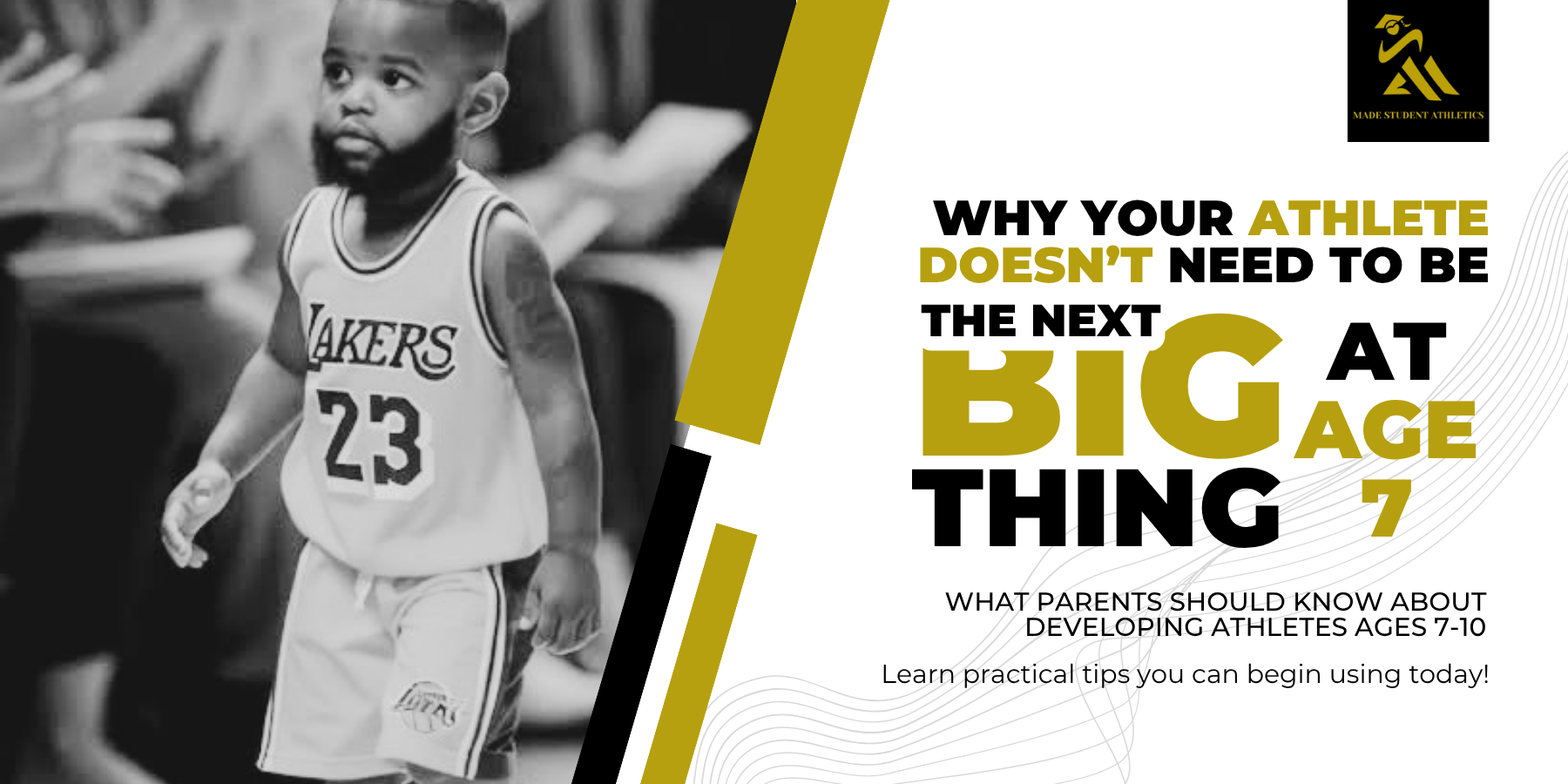
We know, we know, we know…
Every day there’s a new post, highlight, or mention about the next 1st-grade phenom.
We’re seeing the “rankings” of the Top 6-Year-Olds in the Nation across various sports platforms.
And we understand how that can make parents wonder if their child is somehow falling behind in sports.
Imagine that—behind at age 6.
If your child happens to be recognized as the future of professional sports while they’re still in elementary school, more power to you!
But for everyone else, here’s what you should know about developing your young athlete between ages 7–10.
The Introductory Stage
There’s a big difference between athletic achievement and athletic development. When a child is between 7 and 10 years old, the most important question isn’t:
“How do we make them a great athlete?”
It is:
“How do we help them become a young person who believes they can become great?”
The first stage of development is what we at MADE call the Introductory Stage. It is a period when young athletes are beginning to discover themselves, discover sports, and discover what they are capable of accomplishing. And those discoveries can shape their relationship with athletics for years to come. At this age, children are still learning about themselves, their bodies, and the world around them. Athletic development should introduce foundational skills while helping children build confidence and a positive relationship with sports.
That means giving young athletes opportunities to:
- Learn basic movement and athletic skills
- Develop coordination and body awareness
- Try new things without fear of failure
- Build confidence through small successes
- Learn how to listen, communicate, and work with others
- Develop a love for being active
- Most importantly, it should be fun
Build Confidence Through Earned Success
One of the most important principles during this stage is helping young athletes see themselves as successful and capable.
That doesn’t mean telling a child they’re the best at everything.
In fact, constantly telling a child they’re the best can create a fragile form of confidence—one that becomes difficult to maintain when they eventually encounter someone faster, stronger, or more experienced.
Instead, young athletes need opportunities to experience real, earned success.
Success might mean:
“I finally made that shot.”
“I learned a new movement.”
“I didn’t quit when it got hard.”
“I listened to my coach.”
“I helped my teammate.”
“I tried something I’ve never done before.”
These moments teach children something much more valuable than simply winning a game:
“I can learn. I can improve. I can overcome challenges.”
That belief becomes a foundation for future development.
Feed Their Passion with Fun and Variety
Fun isn’t a distraction from development—it’s part of development
One of the biggest mistakes adults can make with young athletes is believing that serious development requires serious training all the time.
It doesn’t.
For a 7-year-old, a 9-year-old, or a 10-year-old, fun is a developmental tool.
When children enjoy what they’re doing, they’re more likely to participate, explore, practice, take risks, make mistakes and come back again. This is extremely important because lasting athletic development doesn’t happen in one workout. It happens through years of participation.
Exposing young athletes to a wide variety of sports is another way to keep things fun and interesting. This allows young athletes to continue learning about themselves and the things they enjoy. Additionally this creates an opportunity for a wide variety of positive athletic experiences. A young athlete who associates physical activity with positive experiences is more likely to develop a lasting relationship with being active.
Training at the introductory stage should feel less like a professional training camp and more like an adventure in athletic discovery .
Build Their Athleticism Through Fundamental Movements
The foundation for great athleticism in any sport is quality movement. Youth between ages 6 to 10 should be introduced to foundational athletic skills and guided through fundamental movements in ways that are appropriate for their age and experience.
These can include:
Movement — running, jumping, landing, changing direction, balancing, and controlling the body.
Coordination — learning how different parts of the body work together.
Sport skills — beginning to develop the basic skills associated with the sports they enjoy.
Awareness — learning to recognize space, teammates, opponents, equipment, and their surroundings.
Communication — listening, responding, asking questions, and interacting with coaches and teammates.
Problem-solving — learning how to respond when something doesn’t work the first time.
This highlights another benefit of exposing young athletes to a variety of sports early, which is the chance to practice the above skills in a variety of settings. All of this gives children a broad athletic foundation that they can build upon as they grow.
Don’t Rush the Process
Every young athlete develops differently.
One child may be naturally coordinated. Another may need more time to develop balance and body control. One may immediately love competition. Another may need time to become comfortable in a competitive environment.
That’s okay.
A child who isn’t the strongest 8-year-old in the gym isn’t necessarily behind.
A child who struggles with a particular skill isn’t necessarily lacking potential.
And a child who isn’t ready to specialize in one sport doesn’t need to be forced into specialization simply because other children are doing it.
Development isn’t a race.
When it comes to athletic development the old adage is true: don’t rush the process, trust the process.
Get Started Today
The Introductory Stage is just the beginning of the Holistic Student-Athlete Development Model™.
At MADE Student Athletics, our goal isn’t simply to train young athletes to perform better today.
We want to help them develop the physical, mental, and socio-emotional foundation necessary to continue growing tomorrow.
Is Your Young Athlete Ready to Start Building Their Foundation?
If you or someone you know has a child between 7 and 10 years old, this is an ideal time to begin developing the foundational skills, confidence, and habits that can support their athletic journey.
Allow us to help. Click Here To Book A Session With Us Today.
Also check out our Intro to Sports program here for a unique way to get your child off to a great athletic start.
Don’t rush your child’s development. Build it.
MADE Student Athletics — College Sports Ready.
Bonus Tip! Supportive Parent: The Most Important Position – Play It!
Parents don’t have to become their child’s coach.
In many cases, one of the most valuable things a parent can do is simply create an environment where their child feels supported.
Instead of focusing every conversation around performance, try asking questions such as:
- What was your favorite part of practice today?
- What did you learn?
- What was challenging?
- What did you get better at?
- Did you help someone today?
- What do you want to try next time?
Notice that none of these questions begin with:
“Did you win?”
Winning isn’t bad.
Competition isn’t bad.
Wanting to be good isn’t bad.
But at this stage, children are developing much more than athletic ability. They are developing their relationship with success, failure, effort, competition, and themselves.
That relationship matters.